Batteries, cards & accessories
Mounting and securing a trail camera
Fix a trail camera firmly at the right height and angle, and deter theft with a lock, security box and a careful choice of spot.
- Time
- 30 minutes
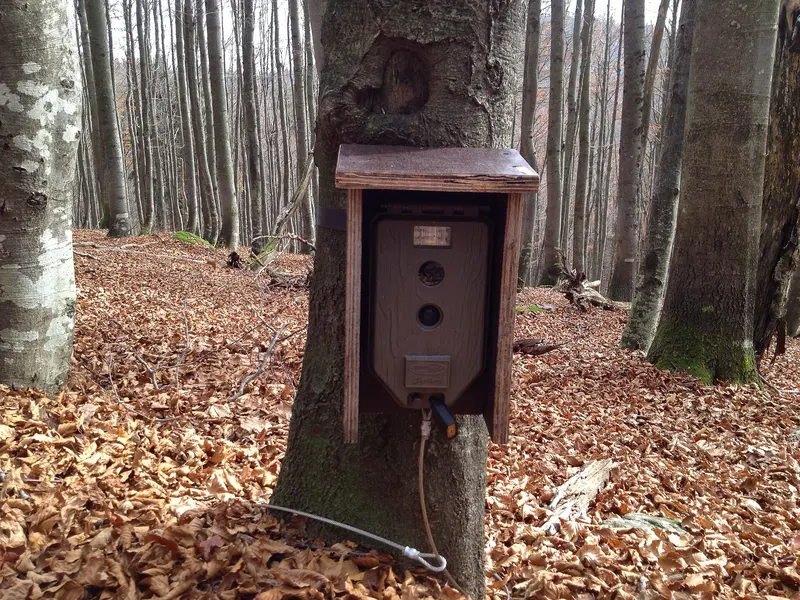
- Difficulty
- Easy
- Cost
- Moderate cost
- Steps
- 7
- Checked
What you’ll need
- Trail camera with strap
- Python-style cable lock Search Amazon for trail camera cable lock
- Steel security box made for your camera model (optional) Search Amazon for trail camera security box
- Camera mounting bracket or ground spike (optional) Search Amazon for trail camera mount
- Tape measure Search Amazon for tape measure
As an Amazon Associate we earn from qualifying purchases. The Amazon links go to search results, so you can compare what’s available.
Safety first
- Get the landowner's permission before fixing anything to trees or posts you don't own, and don't drive screws into trees on other people's land.
- No lock stops a determined thief. Don't leave a camera where losing it would be a problem, and don't record people beyond your boundary. See privacy and neighbours.
Step by step
-
Step 1: Choose a solid support
A strong, straight trunk or post stops sway, which can cause false triggers and blurred images. Bushnell suggests a sturdy tree of about 15 cm diameter. MammalWeb warns that small trees sway and can get broken. In a garden without trees, a fence post, a bracket on a wall or a ground spike can work.
Next: step 2 -
Step 2: Strap it on or use the tripod socket
Most cameras come with an adjustable strap that threads through slots on the back. Pull it tight so there's no slack. Many also have a standard 1/4"-20 tripod socket for brackets and mounts, as Bushnell's manual describes.
Next: step 3 -
Step 3: Set height and angle
For most UK mammals, aim for roughly 30–60 cm high (MammalWeb uses about 60 cm), facing straight ahead rather than tilted. Bushnell suggests about 1–1.5 m and 5 m from the target for deer-sized animals. If the trunk leans, use a wedge, bracket or the camera's levelling arm to straighten the view. See where to place a trail camera.
Next: step 4
-
Step 4: Add a cable lock
A Python-style lock uses a braided steel cable through the camera's lock point and around the trunk. Bushnell's cameras, for example, have a lock hole on the case. Fit it snugly so the camera can't be slipped off.
Next: step 5 -
Step 5: Consider a security box
Steel security boxes are made to fit particular models. Browning's, for instance, has channels for Python cable locks and takes a padlock. Buy one made for your exact camera so the lens, PIR sensor and IR LEDs aren't blocked.
Next: step 6 -
Step 6: Keep it discreet
Mount where people are unlikely to look, and consider no-glow IR in places at risk of theft, as NatureSpy suggests. A 4G camera can also send pictures before anyone can take the card.
Next: step 7 -
Step 7: Record and check
Note the height and position, as MammalWeb suggests, so you can put the camera back in the same place after changing batteries. Check the strap after storms.
Tips
- Fit the lock so it doesn't cover the lens, PIR sensor or IR LEDs.
- A short length of wood behind the camera can correct the angle on a leaning tree.
Questions people ask
How do I stop my trail camera being stolen?
Use a cable lock and a security box made for your model, mount it out of sight, and consider a no-glow camera. A 4G model can send images before it's taken.
Can I mount a trail camera without a tree?
Yes. Use a fence post, a wall bracket or a ground spike that fits the camera's 1/4"-20 tripod socket.
How tight should the strap be?
Tight enough that there's no slack and the camera can't swing. Movement can cause false triggers.
Sources
Checked 18 October 2026. We wrote this guide in our own words, using:
- Bushnell Cellucore 30 instruction manual (copy hosted by Adorama) (adorama.com)
- MammalWeb tips for good camera trap placement (Great North Museum) (northeastmuseums.org.uk)
- MammalWeb camera trapping tips and tricks (Great North Museum) (northeastmuseums.org.uk)
- NatureSpy: trail camera placement guide (naturespy.org)
- NatureSpy: basic features and settings of trail cameras (naturespy.org)
- Adorama: Browning BTC-SB trail camera security box (adorama.com)
- Academy: Stealth Cam Python cable lock (academy.com)
- Moultrie support: too many pictures (false triggers) (support.moultriemobile.com)
Was this guide helpful?
Report a problem with this guide
Printed from wildlifetrailcameras.co.uk/guides/mounting-and-securing-a-trail-camera/ · Checked 18 October 2026 · Research reviews, not hands-on tests: specifications come from manufacturers and findings from the independent reviewers we link to. Check the law before filming beyond your own property.