How to film hedgehogs with a trail camera
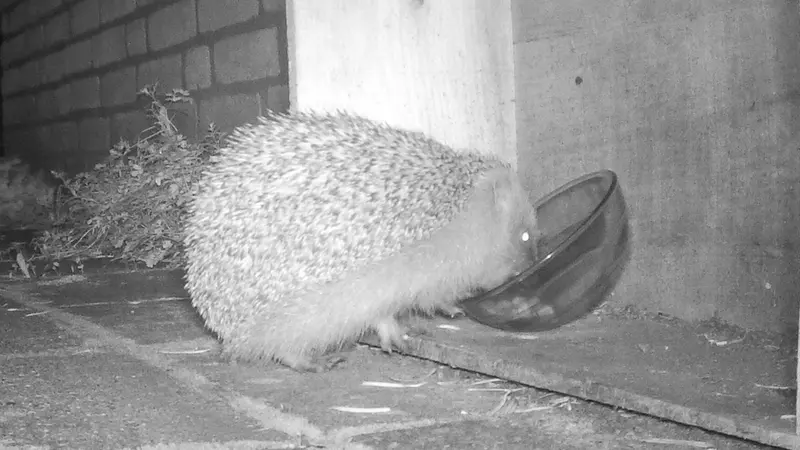
Set a trail camera low, near a simple feeding station and a hedgehog gap, and you have a good chance of filming the hedgehogs that visit your garden at night. This guide covers camera height and angle, safe food, and where to send your records.
- Time
- 1 hour to set up, then a few weeks of nights
- Difficulty
- Easy
- Cost
- Low cost
- Steps
- 8
- Checked
What you’ll need
- Trail camera with no-glow or low-glow infrared
- Lithium AA batteries Search Amazon for lithium AA batteries
- SD card (check your camera's manual for size and speed) Search Amazon for micro SD card
- Short stake or post to mount the camera low Search Amazon for trail camera ground stake
- Plastic storage box for a feeding station Search Amazon for plastic storage box with lid
- Meaty hedgehog food, wet cat or dog food, or cat biscuits Search Amazon for hedgehog food
- Shallow water dish
As an Amazon Associate we earn from qualifying purchases. The Amazon links go to search results, so you can compare what’s available.
Safety first
- Never give hedgehogs milk or bread.
- A hedgehog out in daylight that is lying still, has flies around it or is struggling to walk needs help straight away. Pick it up with gloves or a towel, put it in a high-sided box indoors with water and meaty cat or dog food, and call a local rescue or the BHPS on 01584 890 801.
- Keep the camera within your own garden. If it films a neighbour's garden or the street, data protection law applies.
Step by step
-
Step 1: Give hedgehogs a way in
Hedgehogs roam between gardens at night, so a closed-in garden gets fewer visits. Hedgehog Street says a 13cm x 13cm gap is enough for any hedgehog and too small for nearly all pets. You can remove a brick at the base of a wall, cut a hole in a fence panel or dig a channel underneath. Label the gap so nobody blocks it, and add it to the BIG Hedgehog Map.
Next: step 2 -
Step 2: Build a simple feeding station
The British Hedgehog Preservation Society (BHPS) suggests a plastic storage box with a 13cm x 13cm entrance cut in one short side (tape over the sharp edges). Put food and water at the back, a brick on the lid so it can't be moved, and a second brick about 13cm in front of the entrance so bigger animals can't lie down and hook the food out. The Mammal Society goes further and recommends feeding stations with two exits. Some cats still squeeze in, so expect some trial and error.
Next: step 3 -
Step 3: Put out the right food and water
Hedgehog Street suggests meat-based wet dog or cat food, hedgehog food or cat biscuits, with a shallow dish of water. Never give milk (hedgehogs are lactose intolerant) or bread (it has little food value). The Mammal Society also advises against whole peanuts, mealworms and fish-based foods. Keep portions small: this food tops up their natural diet of beetles, caterpillars and worms rather than replacing it.
Next: step 4
-
Step 4: Mount the camera low
Hedgehogs are small and low to the ground, so a camera strapped to a fence at chest height will mostly film the tops of their backs, or miss them. The Nottingham Trent University Spot a Hog survey asks people to fix the camera firmly to a post or small tree at about 25cm above the ground. Aim it so the ground fills roughly two-thirds of the picture and the sky (or background) one-third.
Next: step 5 -
Step 5: Frame the station and clear the view
For close-up clips, point the camera at the feeding station entrance or the hedgehog gap from a metre or two away. For counting, Spot a Hog asks for a clear view at least 3m deep (ideally 7m) and 3m wide. Either way, trim grass and stems right in front of the lens: moving plants are the main cause of empty clips that fill your card.
Next: step 6 -
Step 6: Choose your settings
Set the date and time correctly (some cameras use the US month/day order) and record day and night: hedgehogs are mostly nocturnal but can be seen in the day. For watching behaviour, short video clips work well. For survey work, Spot a Hog asked for photos only, in bursts of 3–10 shots. A no-glow or low-glow infrared camera is less likely to be noticed at night. See our settings guide for details.
Next: step 7 -
Step 7: Leave it alone and check the results
Leave the camera running for a week or more before judging the spot; Spot a Hog runs each survey for 30 nights without moving the camera. Check the card in daylight, top up food and water, and clean the feeding station regularly (the Mammal Society suggests roughly monthly, or every two weeks if lots of species visit).
Next: step 8 -
Step 8: Share your records
Your clips are useful to conservation. Log sightings on the BIG Hedgehog Map (run by PTES and BHPS), and upload camera trap photos to MammalWeb, where volunteers identify the species. You can also record hedgehogs alongside birds in BTO Garden BirdWatch. Delete or crop any frames that show identifiable people before sharing.
Tips
- If foxes or badgers visit your garden, keep food inside the feeding station: the Mammal Society advises not attracting them where hedgehogs visit, since predation is a natural risk.
- Use more than one bowl if several hedgehogs visit, to reduce squabbles.
- A camera aimed along a fence line or at a gap often catches hedgehogs passing through even without food.
- Put the feeding station away from any hedgehog house so food doesn't draw other animals to the nest.
When to get expert help
A local hedgehog rescue or the BHPS helpline (01584 890 801) if you film a hedgehog that looks injured, unwell or out in the daytime.
Hedgehog food: quick reference
| Offer | Avoid |
|---|---|
| Meaty wet cat or dog food | Milk |
| Hedgehog food | Bread |
| Cat biscuits | Whole peanuts, mealworms, fish-based food (Mammal Society) |
| Shallow dish of water | Large portions that replace natural food |
Questions people ask
Do I need a licence to film hedgehogs?
No. Natural England says you don't need a licence to film wildlife as long as you don't disturb it, and hedgehogs aren't one of the species it lists as needing a photography or survey licence.
What height should a trail camera be for hedgehogs?
Low. The Spot a Hog survey uses about 25cm above the ground, angled so the ground fills about two-thirds of the frame.
What should I feed hedgehogs?
Meaty wet cat or dog food, hedgehog food or cat biscuits, with a shallow dish of water. Never milk or bread.
Why does my camera film nothing but grass?
Plants moving in front of the lens set off the sensor. Trim the area right in front of the camera and avoid pointing it at sunlit leaves.
Sources
Checked 18 October 2026. We wrote this guide in our own words, using:
- Hedgehog Street – Link your garden (hedgehogstreet.org)
- Hedgehog Street – What should we be feeding hedgehogs? (hedgehogstreet.org)
- BHPS feeding station leaflet (hosted by Bangor University) (bangor.ac.uk)
- Mammal Society – Feeding mammals guidance (mammal.org.uk)
- Spot a Hog instructions (Nottingham Trent University) (nbn.org.uk)
- BHPS – Hedgehogs in need of help (britishhedgehogs.org.uk)
- PTES – Log your hog (BIG Hedgehog Map) (ptes.org)
- Mammal Society – MammalWeb citizen science project (mammal.org.uk)
- BTO – Garden BirdWatch: taking part (bto.org)
- GOV.UK – Protected species: when to apply for a licence to survey, film or photograph them (gov.uk)
- ICO – Home CCTV systems (ico.org.uk)
Was this guide helpful?
Report a problem with this guide
Printed from wildlifetrailcameras.co.uk/guides/how-to-film-hedgehogs-with-a-trail-camera/ · Checked 18 October 2026 · Research reviews, not hands-on tests: specifications come from manufacturers and findings from the independent reviewers we link to. Check the law before filming beyond your own property.